THIS JUST IN: The Latest:May 18, 2013 Jowita B's book Drunk Mom: A Memoir is the topic of our Mother's Day blog. |
||||||||||||||||||||||||||||||||||||||||||||||||||||||||||||||||||||||||||||||
Jowita B's DRUNK MOM #6 on Globe & Mail list for Mother's DayThe story behind the book Drunk Mom reminds me struggle that the song "Hit Me With Your Best Shot" went through. Eddie Schwartz wrote the song and couldn't find anyone who believed in it. There's a funny story about a label flying him down to LA to record some demos but they didn't want to do that one. He begged them and said, "Let's do it; if you don't like it, leave it off the demo tape." He recorded "Hit Me With Your Best Shot," they hated it and the producer ordered the engineer to erase the reel to real 1/4 inch. I mean, they really hated it. Lucky for Eddie, the engineer had already made a cassette tape of the demo. It was another year before anyone showed an interest. Peter Frampton was going to record it but while he was on tour, unknown, Pat Benatar was with her agent listening to demos at "Brand X" music and she heard the song being played through the wall. She just had to have that song. The agent didn't think it was a good idea but Pat Benatar wouldn't have it. Zeitgeist's influence in the sausage factory rock industry of the day was just waiting for a feminist anthem to break the trampy 80's mold. Pat Benatar (with Eddie's song) became a sensation in every music market in the world. Looking back, having any man sing it would have been uneventful. Remember, no one who was in the know at gate-keeper central believed in the song. They were wrong. Drunk Mom: A Memoir has released in Australia and in Canada. Based on the splash of publicity the book is about to get in the UK, that market is about to drop the book too. The USA says, "No way." According to Drunk Mom's Doubleday Canada (Random House) team, Random House USA acquisition loves the book but sales say it is unmarketable. People love "Momoires;" people love crash-and-burn addiction stories but never the two shall meet. I bet, Random House will soon see that if they don't release it, someone else will and like Eddie's "Hit Me With Your Best Shot," Drunk Mom will have her Mother's day. The book was like heroin for me. I couldn't stop reading and everything else was secondary. Around 1/2 way through I thought I should try to pace myself because I would soon be out. I regretted it being over. Jowita has a real ease with wielding a metaphor. One addict she describes in treatment as being the type of person others are drawn to, like a camp fire. English is a second language for Jowita but she is never apologetic or overcompensating. The story is unabashed and beautifully vulgar. Here are two "Hit Me With Your Best Shot's." One by composer/writer, Eddie Schwartz and the one that changed the world, by Pat Benatar. http://www.youtube.com/watch?v=0JRgHol94Xc http://www.youtube.com/watch?v=1nvA1OUlKk8 DRUNK MOM: A MEMOIR Here the panel on "Growing Along Spiritual Lines" given by Joe C and Joe R (priest)
|
||||||||||||||||||||||||||||||||||||||||||||||||||||||||||||||||||||||||||||||
| Province |
White | First Nations | Other Visible Minorities | Total Population |
| Ontario | 9,041,210 | 242,490 | 2,754,200 | 12,028,900 |
| P.E.I. | 130,650 | 1,730 | 1,825 | 134,205 |
| Quebec | 6,643,125 | 108,425 | 654,355 | 7,435,905 |
| New Brunswick | 688,655 | 17,650 | 13,345 | 719,650 |
| Nova Scotia | 841,230 | 24,175 | 37,685 | 903,090 |
| Nfld/Labrador | 471,440 | 23,450 | 5,720 | 500,610 |
In a previous blog I quoted the Ontario Human Rights Commission which talks to AA’s responsibility to advocate for minorities.
That previous blog, “What can the Toronto Problem tell us about AAs Population Stagnation Worldwide?” talked about how AA’s own Numerical Data, Policies, Practices and Decision-Making and Organizational Culture shows an outdated lip-service concern for minorities, a failure to accommodate cultural differences within our own fellowship and our outreach.
We are all about attraction—not promotion. But if there is something unattractive about AA for select communities, what is it? If minorities are not broadly represented in our meetings, what could we do to outreach to them?
Going back to Jimmy Carter’s comments it is self-defeating to systemically discriminate against minority groups when it comes to inviting them into the recovery discussion at meetings and policy making at the level of General Service. The reason that this defeats us is that a homogenized voice dulls our senses from the same repetitive messages. By making AA a tapestry of culture and thought, more is added and there is more to feed all of our minds and souls.
It is laziness to passively resign ourselves to the idea that this is just how it is. Ours is a program of rigorous honesty and personal responsibility. It isn’t enough to point the finger, taking GSO’s inventory, for we are looking in the mirror when we look at them. They are at the bottom of our inverted triangle. It is our own group that a start to change for the better begins. Great freedom is bestowed upon our group. Freedom comes with responsibility. Self support means more than tossing two bucks in the Seventh Tradition each meeting. Our time, talent are also needed to keep us sober, growing and free from complacency. So while this time of year invites us to take stock of our General Service Structure, let us not also remember to personally and at the group level, be the example we demand that GSO follows. How can I be more inclusive and tolerant? How can my home group do the same?
Do Twleve & Twelve fellowships dislike nonbelievers?
I was at an NA meeting last night on Step 11. I generally talk about what I believe and what I do to stay clean and sober. I don’t often talk about what I don’t do or don’t believe. I didn’t say a thing at this meeting. I read a paragraph like everyone else and I listened to hear if my experience with Step 11 would be honored or at least acknowledged in the reading. It was not. According to NA, I can assume that atheists are either cured of skepticism by Step 11 and ipso facto have made conscious contact with God as we understand Him. Or are we welcome to tolerate the majority theistic belief but discounted as non-spiritual and therefore unworthy of participating in a discussion of meditation or consciousness because the only Step 11 experience is the unavoidable and irrefutable proof of a power greater than ourselves that we ask for the right stuff in our prayers and hear the answers to our prayers in meditation.?
To believe such a thing is fine. To state it as a universal worldview is delusional. Believing something doesn’t make it true. Being certain doesn’t make it true. We were once sure the world was flat but we were mistaken. People who were right about our spherical world who spoke out about it were more often persecuted than respected. Back then we lived in a “majority rules” world that didn’t respect the minority opinion. We know now that the majority was completely mistaken. This resistance to an alternate worldview looks very unattractive to us now.
Isn’t spirituality about humility? Is close-minded certainty a state of divinity or arrogant megalomania? I would think that certainty about something that can’t be proven is more insane than spiritual. Even if we are by chance right, we are foolish to be so sure.
Back to Box 4-5-9 to address a question that begs to be asked. I was surprised to hear that a French Big Book wasn’t available until 1963. AA was almost 30 years old by then and the Big Book had been almost a decade into its Second Edition. I expect there were rogue versions of French interpretations of Alcooliques Anonymes in every corner of Quebec and France by the time the official version was available. In celebration, Bill W said of the French launch, “This is new and magnificent evidence that A.A. can cross every barrier, can speak in the language of the heart to all who suffer our strange and fearsome malady.”
When will AA print the Big Book in the language of the Nonbeliever?
Will atheistic language in AA be seen as a righteous bridge-builder in the same heart-felt way as reaching out to our francophone brother and sister’s was? There is a way to tell the story of AA and the recovery program of the Twelve Steps without any deity or supernatural force. It is being told and the program is being worked that way now. It always has been. Another story is the celebration of the years of stewardship of Gayle S.R. who curiously is quoted in the Spring issue:
"'Our membership,’ she says, ‘much like the society in which we live, appears to be getting more and more polarized. I have heard from A.A. groups that want to let anyone with any sort of problem come to meetings and share, with the reasoning that ‘a drug is a drug,’ and I hear from their A.A. groups that want to change our literature or institute ‘rules’ so that no nonalcoholic is ever referred to a meeting, or no one who hasn’t worked a particular Step is allowed to share.”
This increased polarization can generate a certain reactivity on the part of some in the Fellowship, says Gayle, nothing ‘the willingness of so many members of A.A. to believe that we make decisions here at G.S.O. that would go against the best interest of A.A. as a whole. Staff members are also members of A.A., so we care just as much as anyone about the integrity of decisions made by the delegates and the trustees.”
What she is describing about how AA is getting is really what it has always been. I have written before about Bill W’s writings of the Pharisees and Recalcitrant’s. Our co-founder has also reminded us that there will always be radicals and traditionalists. So what Gayle is warning us about a trend, is no more than her gradual realization of AA’s diversity.
Is it possible to “care just as much as anyone about the integrity of decisions made” too much? Only if you feel your view of AA is right or counts for more than another’s. Gayle, as a trusted servant, used her position to have a New York agnostic remove their variation of agnostic Twelve Steps from their website. She said in a letter to the webmaster, the following:
“. . . the message of A.A. is about recovery from alcoholism through the Twelve Steps of Alcoholics Anonymous. A group which feels a need to change the 12 Steps and to change the message may be a recovery group, but it is not an A.A. group.
It has long been the case that Alcoholics Anonymous has freely granted permission to a wide range of “Anonymous” recovery programs to adapt the Twelve Steps of A.A. as well as A.A. literature and the Traditions. However, once they have done so, they are asked not to call themselves Alcoholics Anonymous. So we respectfully request that your group stop calling itself an A.A. group.”
In her letter she cited selective chapter and verse of selected AA Traditions and publications. She failed to include, among other more liberal interpretations, this declaration from GSO which first appeared in Box 4-5-9 (Volume 23, No 4) and then reviewed again in 2006:
"Any literature that pertains to the principles of AA or is approved by a GROUP CONSCIENCE - is perfectly acceptable to be read by any AA member or in an AA meeting."
Gayle sees the polarization within AA but could not see it in herself. If there are two camps in AA, one being the “Let’s create a larger tent” faction and the other being the “We must preserve the integrity of the message” camp, then Gayle is clearly a member of the second. The agnostic group(s) are clearly a member of the first. Gayle’s letter was ground for www.agnosticaanyc.org/ removing their version of agnostic Twelve Steps.
Was her letter to New York agnostics an abuse of power? Gayle’s own service manual reminds her that GSO is to “abstain completely from any and all acts of authoritative government which could in any wise curtail A.A’s freedom.” Bill goes on to say on page 72 of The A.A. Service Manual Combined With Twelve Concepts for World Service (2011-2012 Edition), “our Conference will always try to act in the spirit of mutual respect and love—one member for another. In turn, this sign signifies that mutual trust should prevail; that no action ought to be taken in anger, haste, or recklessness; that care will be observed to respect and protect all minorities; that no action ever be personally punitive . . . and that our Conference will ever be prudently on guard against tyrannies, great or small, weather there be found in the majority or in the minority.”
Was Gayle’s enthusiasm to assert the majority worldview in AA a betrayal of her obligation to protect the minority, each group’s autonomy and even our AA given right to be wrong. AA is self-correcting isn’t it? If agnostic Steps don’t work they will go away all by themselves. Every group is a group if it says so. That’s what Bill said and Gayle knew that.
I wrote to her, pleading for reconsideration or explanation. My letter was ignored. There was a victory lap to plan and accolades to indulge in.
The final part of Box 4-5-9 I will touch on is the theme around GSO’s personal inventory. I hope the way we fear ( instead of accommodate) our minorities will be reviewed. I hope that AA can have the courage to do the right thing—not the popular thing—when it comes to encouraging our godless members to tell our story in our language instead of seeing us as a threat to AA integrity. Gayle is not a lone-gunslinger. AA’s underrepresentation of the atheist voice is legion. What is now being tabled as a new pamphlet on varieties of spiritual experiences including agnostics and atheists, started out in 2001 as a pamphlet devoted to atheists and agnostics. All other minorities have their pamphlet—young people, women, aboriginal North American’s, African Americans, the elderly, the GLBT community, members in prison and so on. Why isn’t there a nonbeliever’s pamphlet?
There was a movement to remove agnostics and atheists from a pamphlet that was originally intended for us specifically. The 2010 Conference Agenda Item, “Consider developing Conference-approved literature which focuses on spirituality that includes stories from atheists and agnostics who are successfully sober in Alcoholics Anonymous” caused a stink by the militant faction that is offended by atheism being aligned with success in AA. The intolerant ones don’t want diversity in AA. They want conformity. To them, their sobriety is poof of god and our refusal to see god working in our life is intellectual stubbornness.
The vast majority of AA members are theists. The politest form of bigotry is to be invited to go start your own fellowship. Our founders left behind a pluralist society where people of all shapes, beliefs, and ways of staying sober would be equal and respected. The majority choosing for the minority is not the AA our founders left behind.
Did you know that six recommendations have come from AA’s Literature Committee to print a pamphlet for atheist and agnostics. Everyone was discussed and mothballed. Here’s a history of attempts to have our voice heard. I found this on the Area 17 web site. It has since been removed. I asked GSO to check the minutes and archives to confirm or deny these dates, names and facts. After considerable time I was told, “We don’t have the staff or the time to look it up. Sorry.” READ IT HERE.
The complexities of believers and nonbelievers is very involved and our next blog will report on how much more we know about faith and doubt that the day that We Agnostics” was written.
Stay tuned.
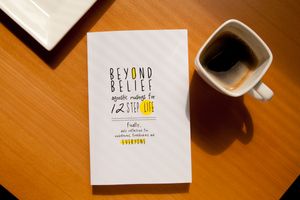
Rebellion Dogs Publishing is pleased to announce the first ever secular daily devotional. Beyond Belief: Agnostic Musings for 12 Step Life – finally, daily reflections for nonbelievers, freethinkers and everyone.
Order yours now: REBELLION DOGS Amazon Page
See 100 pages for free: REBELLION DOGS PUBLISHING.com
Explaining addiction to the professional community
Last week as one of my duties in Public Information for Alcoholics Anonymous I started the first of three ½ days with first year medical students at one of Canada’s top schools. I started by saying that I didn’t want to talk about something that was obvious to them so I wanted to see if we had a consensus on what we are talking about.
I asked, “By a show of hands, who sees alcoholism as a disease, as an illness.” Two hands timidly went up a couple of others looked around to see to how the others responded. One of those raised their hand ½ way up and back down again.
“OK,” I said, “The American Medical Association classifies alcoholism as a disease, however controversial that is, but I see there in consensus on this theory here. How about alcoholism as a behavioral problem—an addiction that has to be corrected by reprogramming or cognitive behavioral therapy like smoking or poor eating habits?” A few of the the ten students rose their hand for that one. I said, “There is no right or wrong answers here and AA has no opinion or a position in public debate on the topic.”
“Well then, who sees alcoholism as a moral failing or a spiritual malady?” Not one student budged. “Well, that’s good, I think for us alcoholics that you don’t see addiction as a moral failing. Before Alcoholics Anonymous existed, history recalls that the medical profession saw inebriants as morally depraved and not worth the medical community’s limited time or energy. We were left to die of alcoholic complications or put in a sanatorium if we had become a nuisance to others. So I am pleased to see you don’t view us as reprobates.“
This started a discussion about how many AA’s anecdotally accept the physical allergy, coupled with a mental obsession description of alcoholism but AA wasn’t all that interested in whether the chicken or the egg came first—rather we tend to eggs as best we can. We have no experts in Alcoholics Anonymous in either alcoholism or recovery. We have experience—not expertise as our currency. We each have our experience of alcoholism that we relate to each other. The two million of us that are AA members have each found a few or many that we identify with in the stories and experience that are shared at meetings.
“Between us here today, we seem to be the seven blind people and the elephant about this beast called alcoholism.” I said to the students. “We all have our limited experience to which we have drawn some conclusions. Perhaps none of us grasp the whole picture. I hope that, through this process together, we can all leave here with a greater grasp of what this affliction called alcoholism is and how the medical and peer-to-peer community can work together to do a better job at limiting the morbidity and mortality that alcoholism brings to bear on society.
The first day followed with the history of AA, what we are and we are not, the Steps and Traditions, what an open or closed meeting would be and what might take place at each of these. CPC came in to talk about the rich history of cooperation between AA and the medical world. Our Area CPC chair and some stories about common misconceptions held by medical practitioners and how they are dispelled, in part, just by engaging in the conversation about addiction and recovery. AA members shared their stories of what it was like, what happened and what it was liked now. Often, members would speak directly to times that they evaded medical help or cases where practitioners carefully tended to symptoms such as strep-throat and depression without getting an accurate assessment of the cause, or in some cases, not even asking about how much we drank and how often. The symptoms were treated but not the cause.We know that influenza is a virus, cancer is unregulated cell growth but what is alcoholism? And why do cancer and flu victims seek help and alcoholics evade detection? It remains a wonder to me that like the cold or cancer, the medical world has not arrested the problem of alcoholism. Certainly no one has been able to inject the addict with a desire to stop acting in a self-destructive way. We can’t present more articulate arguments, we can’t scare them and we can’t medicate addicts and alcoholics to sobriety.
Over the first two days the students got to hear three stories:
• A suburban grade A student who found smoking drugs and drinking and before she finished high school was a homeless dropout panhandling and suffering the indignities of any woman on the streets with no means of support. She got pregnant and after fantasizing about how cool it would be to raise a homeless child on the mean-streets, off the radar, she gave the child up for adoption in exchange for burden-free drinking. Realizing what she had done she went to treatment and went back to get her son. It took her two years of relapsing for recovery to take but she got sober, went back to school, got a scholarship, became a lawyer and is now running a practice, raising a boy and going to meetings.
• A teenager from a good home, school and carefree life found weed, cocaine and alcohol and was eventually confronted by an intervention and sent away to a sober treatment centre and has clean and sober since 18, active in 12-Step work, the AA young people’s movement and higher education.
• A second generation alcoholic went from growing up in the shadows to abuse and alcoholism to getting sober, getting educated and relapsing into sex and drug addiction after 22 years of sobriety, trying new drugs he never tried before. He’s sober again a couple of months and battling criminal charges and is a patient for both anxiety disorder and complications from his relapse.
This is what alcoholism (and drug addiction) is. We can’t qualify or quantify it but the best we can do to explain it to medical students is to tell them our story. And no single story can tell the whole story. But now they know, although they can’t explain it to another. Hopefully, in their practice they can identify the symptoms and confront one or two of us before it’s too late.
Maybe, just maybe, one of them will have something to teach us about addiction one day.
Future Shock 2035: Stewardship in the 21st Century
Let us imagine that today’s new process or substance addict has used for the last time and they recover. Also, let us assume that they stay around. Not everyone does. Twelve Step culture becomes a way of life for some of us while for others it is a leg up into a clean and sober productive life outside being a loyal member of a regular meeting home group. So, for the purposes of this mental exercise, we are assuming that today’s newcomer (it could be you or it could be someone you stayed up until midnight talking with last night) has had their last drunk, high or acting out experience and it is onward and upward for this now shaky woman or man.
While we are exercising our imagination, why not also imagine the year 2035 and that this newcomer is tomorrow’s long-timer. The history of Twelve Step fellowships will then be 100 years old and today’s newcomer will be 22 years sober at the centennial of the first AA member’s last drink. Damn few of today’s 22 year sober members imagined being a power of example or steward of the Traditions and fellowship back when they “put the plug in the jug” for the last time. It would be hard to imagine for today’s newcomer, too.One more assumption we are making of course is that Twelve Step/Twelve Tradition fellowships are still around in 2035 and they haven’t gone extinct, giving way to some new means of peer-to-peer methodology. I am sure many experimental scientists today are hopeful that addiction will be a thing of the past in 2035. Someone in a lab coat somewhere or several someones in several labs are invested in something that they hope will medically relieve the physical, emotional and mental experience that is addiction.
So if AA is still here for its centennial birthday and/or many of the Twelve Step models that followed are still kicking, what will have changed and what will have stayed the same? All of today’s old-timers will be dead. Fellowships will be run by people who are just getting or are not yet sober. For those of you that are waning, maybe thinking, “That’s enough Joe—what’s the point of playing ‘what-if’ so far out into the future?” I ask you to bear with me for two more minutes. Today’s decisions that are made at the group level and at the world level for each fellowship are, as they have always been, done for the benefit of those of us here in the program and those yet to come. I don’t think it is folly or grandiose to stretch our imagination and ask how we can preserve and prepare our fellowship for the next generation (or two) of those who need us.
Through history, all organizations and societies grapple with the poles of preserving the message vs. widening the gateway. I was emailing briefly with an AA member who has served at General Service Office. He started there before there was an aa.org or a fourth edition of the Big Book and he has seen many things change and many things stay the same. He cares about the fellowship and has been there for many of our critical crossroads. He also has been studying other, older spiritual societies who struggle with growth and reification. I have been thinking a lot about what he told me and because I haven’t asked him if I could splatter the internet with his intimate thoughts, I will keep the member anonymous. Here’s is what he shared with me this weekend:
My exploration of the early history of various spiritual movements suggests there's always a tension between the "Integrity-of-the-Message" types and the "Big-Tent" types. This occurs in most movements no matter what the nature of the movement. The tension seems to intensify after the founder or founders pass from the scene and are no longer there to directly re-interpret what THEY meant, or otherwise arbitrate the dispute. That part of it seems fairly normal. My observation, though, is that sooner or later the "Integrity-of-the-Message" types tend to gain the upper hand in most movements, since they're usually more determined regarding their position (or more arrogant, as the case may be). They then either put the movement out of business entirely by their exclusivity, or they push it forward as a more cohesive group, but they can accomplish the latter only if in the meantime the movement has secured another power base to sustain itself, like money (lots of it), political power or governmental imprimatur. That's generally the sad part.
In AA's case, where money and power are thought not to be a part of the equation, the issue may be a bit more balanced in the long run. There's also the fact that AA has always denied being a "generalized" spiritual movement directed at a universal world view, but one directed—with a "singleness of purpose"—only at a specific medical condition. I think Bill W. always relied on this rationale to favor the "Big—Tent" view. He assuredly did so with respect to issues of race, color and sexual orientation. From a personal basis he also stretched the "creed" part in the case of Catholics and Jews to broaden the AA universe. The circle was always enlarged to include, rather than exclude, on the basis that none should be denied access to a potential cure for a disease or malady. The cure wasn't to be withheld because "the doctor" had personal objections to the patient's personal beliefs, or even to the lack thereof. Bill never lost sight of this one overriding goal in AA's formative years—get the sufferer the help he needs. I'd hate to see AA (lose sight of this) now.
In my book of daily reflections, Beyond Belief: Agnostic Musings for 12 Step Life I focus on the day to day realities of addiction, recovery and the journey of both. Also, I do invite the reader to honor and understand the past, as well as look to the future. If we think the future just happens, there is no “someone” or committee driving the train of our fellowship(s). The groups direct the fellowship and the members direct the groups. The future of Twelve and Twelve life will be decided where members meet—not around board room tables. If we believe in a guiding force that guides group conscience, let’s not forget that this guiding force was present to witness many monuments rise majestically, only to erode back into dust. Fate isn’t on our side if leaving a legacy is our plan. An old saying goes something like this: “Man makes plans and Allah laughs.”
This blog is not intended to be fatalistic. I am not saying let’s stand on the deck of our Titanic, wait for the iceberg and say, “I knew it.” There is much to accept that I cannot change. But there is much to rise to the occasion of to facilitate, preserve and prepare. The question for me is where will I invest my thoughts and actions? Will I throw my hands in the air and declare, “What will be, will be,” or will I do my part to preserve and prepare our fellowship for the needs of tomorrow’s suffering addict?
Feel free to “Pass it On” as you see fit. Send this blog to some of your friends
Order Beyond Belief or link to or like it HERE
Comment or contact Rebellion Dogs Publishing
Author, lecturer, historian Dr. Ernie Kurtz shares about his experience with Beyond Belief
Beyond Belief: Agnostic Musings for 12 Step Life
Daily reflections for nonbelievers, freethinkers and EVERYONE
A commentary by Ernest Kurtz, Ph.D.
Ernie Kurtz received his Ph.D. in the History of American Civilization from Harvard University in 1978. Dr. Kurtz was the first researcher to be granted unrestricted access to the archives of Alcoholics Anonymous. Hazeleden had the wherewithal to publish Ernie’s Ph.D. dissertation—the book that resulted was, Not God: A History of Alcoholics Anonymous. Along with Katherine Ketcham Ernie gave us, The Spirituality of Imperfection: Modern Wisdom from Classic Stores (1992), and a book that demonstrates Kurtz acute understanding of addiction, Shame and Guilt (revised and updated in 2007). For those in the know, catching an Ernie Kurtz lecture on his academic study of spirituality would be a life-altering experience. For those of us who missed that opportunity, there is more of Kurtz on addiction and spirituality in the 1999 The Collected Ernie Kurtz. There are been other books and other writings, both scholarly and popular but today, Rebellion Dogs are honored to share Dr. Kurtz’s experience with reading the musings of Beyond Belief.
Beyond Belief terms its offerings musings rather than “meditations.” The O.E.D. gives the first meaning of the verb muse as “to be absorbed in thought; to meditate continuously in silence; to ponder.” Absorbed . . . ponder: this book is not light reading. I have not so far wanted to fight with it, but I do find Beyond Belief often challenging, sometimes provocative, unfailingly stimulating.
The book is aimed at a general 12-Step readership, but it is mindful that there heretofore exist no such aids for unbelievers, freethinkers, and the unconventionally spiritual. Given that the latest Pew survey found that twenty percent of the American people list their religious affiliation as “None,” it is certainly time that the Recovery world took into consideration this population's needs. Beyond Belief addresses that need in a confident, non-aggressive way. I doubt that any believer will find anything objectionable in its pages. This believer, for one, finds much that is spiritually helpful.
If I have one criticism of this book it is that its musings are too rich. On quite a few pages I wished to pause and think after virtually every sentence. For many, reading Beyond Belief will require a pen or pencil in hand and perhaps a notebook on the side.
This is the first daily reflection book of which I know that offers a lengthy (17-page) “Notes” section as well as a full Bibliography. The Notes are far more than mere citations, often presenting brief additional discussion and even new material that more frequently than not is as rich as the text itself.
In addition to the Notes and Bibliography, the end-matter of Beyond Belief contains full Index that allows searching out individual musings on just about any topic. Having problems with “ego”? Check out May 29, August 8, September 24 or seven other dates. Polishing your gratitude? Flip to March 2, June 16, November 12 or eleven other dates.
Beyond Belief: Angostic Musings for 12 Step Life will enrich anyone interested in living a 12-Step life.
Bob K is a contributing editor aaAgnositca.org and he had this to say about Beyond Belief's agnostic musings after cracking his copy open:
"I expected his book to be good. I was wrong. It’s WAY, WAY better than good. The book is outstanding. Two decades of not being a ‘daily reflections’ kind of guy are over. Now I have reflections worth reflecting over! Buy this book or you will suffer a horrible and painful death! Well, maybe not, but you’ll be missing out on something very good."
This week, Bob offers some post-game colour commentary on the iconic Ebby Thacher. Check it out HERE
If you would like to share Ernie’s thoughts on the book, how about passing on this link from Rebellion Dogs Publishing:
https://www.createspace.com/4127122
For more Ernie Kurtz - http://hindsfoot.org/ktcek1.html Hazelden Publishing YouTube video with Bill White
Being open to new experiences... or not
Neophobia is defined as a fear of new things, Neophilia as an attraction to new things on page 148 of The Righteous Mind: Why Good People Are Divided by Politics and Religion, Johnathan Haidt.
He describes conservatives as change-resistant neophobics and liberals as open-to-new-experience neophiliacs. I see that I am both. I see that either of these as extremes in my personality can be very damaging. When I was drinking and using drugs I thought that new experiences would shield me from the stillness of life where my feelings always confronted me. I thought it was because I was so rock-n-roll, such a wild and crazy guy but it was because I was an escape artist.
Even in recovery I have a bag of tricks for escapism that won’t change my dry date per se, but these diversions will crush the quality of my sobriety. I can also be rigid (neophiliac) and I can resist changes in life, be it changing a ritual in my home group or upsetting my routine in some other way.
Bill Wilson said something to the extent that we have to accept that AA will always have its fundamentalists, its radicals, and its traditionalists. I guess he was making a similar observation. So everyone-are you a “philiac” or a “phobic” when it comes to new experiences?
Joe C, Toronto Canada
BTW, if you are open to new experiences and you have never ventured over to AAagnostica, Carol M wrote the first ever review of Beyond Belief: Agnostic Musings for 12 Step Life
You can join that conversation at AAagnostica
Own your own copy of Beyond Belief (buy in any currency) HERE
A blog entitled “Where’s my damn book?”
How frustrating is it to be a customer awaiting a product that will be delivered “any day now,” everyday? How Early adapter—someone who puts their money on the line to help a noble cause, for a promise of delivery, are to be rewarded for their loyalty—or they should be.
This feeling is a feeling I know. I am a customer more times during the day than I am a product or service provider. When I am disappointed by a bank, a mobile phone or internet provider or a restaurant, the great insult to injury is their desperate appeal for me to understand how difficult this is for them. “What I need you to understand …,” is often the last thing I hear because that’s when I stop listening. What I actually need to understand is that the company is empathetic about my needs and that they are bending over backwards to make it up to me.
And as much as this blog is, in part, to update buyers of Beyond Belief: Agnostic Musings of 12 Step Life, if you don’t read all the way to the end I want you to know that I feel your pain and Rebellion Dogs is rushing to bring our product to market but not at any costs. We want the book to meet your expectations. A year from now you’ll be very aware of how good or bad the book is, even if you don’t remember the emotional cost of having to wait another week or two.Here is something I do know from running a business 101: Under-promise and over-deliver. A client’s satisfaction is a measurement between her or his expectations vs. her or his perception of the results. It’s true in serving a cup of coffee and it’s true in one’s love life—expectations and results, or more importantly our perception of the results will dictate how satisfied each of us will be.
So, knowing this, when I finished writing Beyond Belief in September or October, it seemed that targeting the holidays as a launch, I could get the news out right away and then exceed reader expectations; perfect. A pre-Xmas delivery went from improbable to impossible and at that time, January 10th looked like the outside drop date, even accounting for possible hic-ups along the way. Here we are, January 15th and “any day now” is still our official status. That sucks for you, and everyone waiting for a book. Your frustration is not a feeling I can undo. It’s also embarrassing for me, but let’s not worry about me right now.
First of all, every delay has had a silver lining. That silver lining is that with each delay the book gets just a little bit better. That’s good. Secondly, I feel like I should have been able to anticipate some of this. I can’t anticipate every obstacle or control every outcome but did I learn nothing from the music business? Young bands leave the recording studio, all excited about their new CD. I see this all the time. They book a venue for their CD release party and make posters. In most cities, you have to book two months in advance if you want a premier venue. Bands figure that two months will be lots of time to get the CD mastered, the artwork done and CDs printed and packaged.
Half the time, they are right. However, all it takes is one rights-release for a sample used in the album to be contested or delayed. Or what if there is a flaw in the master CD? Any number of unforeseen delays could mean that the whole project is setback 45 to 90 days. Bands still book CD release parties, album listening sessions and tours before they have the physical product in their hands. Then the big day comes and they are empty-handed. I see it all the time, yet here I am, red-faced from a situation that experience might have helped me anticipate.
A manager from a woman's treatment center that ordered books from us just laughed. Their hospital has published a number of books and reports of their own and she knows about delays. As she has a saying that has worn on her over the years: "Deadlines amuse me."
Getting a book to market is like playing dominoes. If any domino in the chain doesn’t execute as planned, the other dominos can’t make up for the rouge tile. So there have been a few rogue tile sand here is where we stand with the eBook and paperback versions of Beyond Belief: Agnostic Musings of 12 Step Life.
The eBook version is logistically a time consuming project. There are static and interactive eBooks. Static books are electronic versions of print—there is no interactivity. Interactive books allow users to move back and forth, look up definitions, go to end notes and back again and so on. We want our eBook to be cutting edge. There are over 100 end notes. There are over 1,300 links to 120 index/subject topics that we want to be hyperlinked to the corresponding pages for readers that want to see what there is to say on Traditions, relapse, codependency or Jungian individuation. People don’t start this book on page one—January 1st. If you start the book on August 19th, that’s page one for you. You won’t get to August 18 for 365 days. So the table of contents has to link to over 365 different pages to let people start anywhere.
The 12 & 12 community has no such tool for recovery. That’s because there is no template and we are having it made for us—for all of us, actually.
The paperback has had a few challenges. What’s in a font? Well not everyone has every font and if someone in the chain of events doesn’t have one of the fonts you started with, so what—they must have one that’s just like it or better. What I have learned about changing fonts is that not all the formatting follows along. For instance, if you lose a font, you might lose, say, all the italics words. In a 410 page document it will take a while to put them all back.
We had our own internal editorial logjam. The last issue was about writing in the we voice which has became the style dating back to the writing of the Big Book: “Many of us exclaimed,” “We know but a little,” “We stood at the turning point,” “Our stories disclosed in a general way what we used to be like, what happened , and what we are like now.” This voice is fraught with traps. If you stay true to the rules of grammar, you have phrases like “our drugs of choice,” “We became our own loving parents towards our own inner children,” “We came to believe in gods of our understanding,” “We cleaned our sides of the streets first.”
What might be grammatically correct would make the writer look like they had never stepped foot into a 12 Step meeting. No one talks like this. So we went looking for the rule. Authorities say, “Don’t do it.” When one insists, one is encouraged to pluralize everything. OK, so I looked for examples. Bill W. might start a sentence in the plural and change gears. On page 69 of Alcoholics Anonymous, writing about our Step Four, we read, “In this way we tried to shape a sane and sound ideal for our future sex life.” “We” is plural, “life” is singular; yet sometimes Bill says, “lives.” This seems to be what I found in Philip Z’s A Skeptic’s Guide to the 12 Steps, Jon Kabat Zinn’s Full Catastrophe Living or many of the books in the Self-help genre. There was no rule. Each daily reflection had to be read out loud and we discussed what sounded right.
So where are we? I expect to look at the final draft January 16th. If it’s excellent we could be on the presses by Monday the 21st. I hate to jinx it but I will boldly say people who purchased a book or books will have them February 1, or to be safe, the first week in February. Otherwise I will leave everyone’s money under their door mat and you can find me busking in Mexico. Yes, I take requests.
A New Years Look at Resolution Making: A celebration of diversity and lessons learned about rigidity
Are New Year’s resolutions a form of taking ourselves too seriously? It is an attempt to make ourselves one more step closer to adequacy or perfection, depending on our perspective. In Beyond Belief: Daily Agnostic Musings for 12 Step Life we visit the resolution tradition of January First with a Taoist perspective. Jon Kabat-Zinn, PhD says, “The Tao is a world unfolding according to its own laws. Nothing is done or forced; everything just comes about. To live in accord with the Tao is to understand non-doing and non-striving. Your life is already doing itself.” This isn’t to say that self-improvement is pure folly. We are reminded, however that we are not trying to achieve worthiness. We are already worthy as fellow erring travelers of the human race.
Rebellion Dogs Publishing is busy seeing Beyond Belief through to its printing scheduled for next week. At this time of annual reflection we are truly grateful for the support that the freethinking recovery community has shown. Those who have pre-ordered paperback and eBook versions of Beyond Belief have put their money where their mouth is in supporting this project and because of the initial support our initial run will be larger than first anticipated. We also want to recognize that early supporters have had to endure our missed target release of pre-holidays and your patience is not something we take lightly. It will be our great pleasure to ensure that you have your copies arrive in your hands before stores stock our book and we would be remiss if we didn’t say, “Thank you.” We hoped to say on this day, “Finally, a daily reflection book for nonbelievers, freethinkers and everyone.” With humility we are saying on this day, “Eventually, a daily reflection book for nonbelievers, freethinkers and everyone.”
Another book we look forward to seeing early in 2013 is Roger C’s (http://aaagnositca.org) collection of alternative Twelve Step interpretations. Nothing deters the forces of dogma and reification like a constant flow of new ideas, inclusivity and flexible thinking. Let’s not forget that in Toronto Canada, agnostic groups are still banned from the Intergroup meeting directory. The voice of agnostic groups has been revoked on the Intergroup floor and removed from Intergroup activity. Although Toronto Intergroup is pleading with groups for help answering the phones, members of agnostic groups are forbidden to help. Of course, exclusivity is not AA culture and will discriminated against by Intergroup, these agnostic groups are respected, rights-bearing equals in AA from the General Service district table, on up to GSO in New York, as are all agnostic AA meetings.
The crime committed that was found worthy of excommunication, according to the Intergroup power structure, was the reading of a secular version of the Twelve Steps at the first ever Toronto agnostic meeting, which continues to grow since its inception in 2009. Good luck finding the rule about nonconformity; there is no such crime and no such rule. The AA Service Manual states that GSO is charged with the preservation of AA’s Steps. This is in no way suggested or implied that this duty of preservation is a mandate to police and enforce group uniformity. If Time Magazine misprinted the Twelve Steps, AA GSO has the directive from the members to ask Time to correct the misrepresentation. However, an AA group is always a group if the group members say they are. Groups can read Twelve Steps, Six Steps, agnostic or gender-neutral Steps.
The point is that the Twelve Steps are not sacred. To make them so is to make a religion and a mockery out of a fellowship devoted to recovery—not theistic conversion. Since AA’s inception there have been the liberals who further expand the reach of Alcoholics Anonymous and militant conservatives who see inclusivity as threatening our singleness of purpose. It was that way in 1936 and it remains the case 77 years later.
So we Rebellion Dogs look forward to celebrating the artistic love that has gone into the Twleve Steps of Alcoholics Anonymous and we look forward to Roger’s collection of these interpretations eventually become a matter-of-fact adjunct to Twelve Step recovery. We also toast Toronto Intergroup and say to them, “We don’t take your bigotry personally. Your fear mongering and protectionist measures are a living, breathing example of why we have Traditions and how somewhere, somehow, each and every valued Tradition is being disgraced at this very moment. Congratulations for violating Tradition One, Two, Three, Four and Five all with one motion. Your historic blunder won’t soon be equaled. Intergroup, you are a glorious example of how fear and rigidity are something that all of us must keep in check so that missteps like yours are contained and don’t become contagious. We hope that AA will still be whole and enjoy a centennial anniversary in another 20 years or so. Hope won’t get us there—only a return to our Tradition of unity will get us to year 100. Thank you Intergroup for reminding us of Rule 62: Let’s never take ourselves too seriously.”
On that note I want to share with one and all, some humor and wisdom I found from a site called “Serenity Found.” May we all remember never to take ourselves too seriously.
Over-Serious Anonymous - A 12 Step Program
(Copyright © Serenity Found 2002-2004 All Rights Reserved. Source: http://www.serenityfound.org/humor/over_serious.html)
1. We admitted that we were powerless over seriousness—that our lives had become unmanageable.
2. Came to believe that only by lightening up could we achieve a state of non-seriousness.
3. Made a decision to turn our constant self-criticism over to our sense of humor and learn to "lovingly and wholeheartedly" laugh at ourselves.
4. Decided to give ourselves a break once in a while, instead of constantly doing searching and fearless moral inventories of ourselves.
5. Admitted to God, to ourselves, and to another human being that our wrongs were often in our heads.
6. Were entirely ready to accept that our [character was] as good as anybody else's and possibly better than most.
7. Quit harping on our shortcomings.
8. Made of list of all persons we thought we had harmed and saw that they'd forgotten all the crap we'd blown out of proportion.
9. Quit making amends for breathing air and taking up a few square feet of the planet's surface.
10. Resigned ourselves to the fact we were going to criticize ourselves at times, but would try to stick to our guns when we knew we were right.
11. Sought through prayer and meditation to calm down and realize we're not responsible for everything.
12. Having experienced immense relief from these steps, we would try to carry this message to other over-serious people and to practice these principles in all of our affairs
Happy 2013 one and all. Please don’t take this blog too seriously.
Thou Shall Not Be Aware: A Tribute to Alice Miller
So, as many of you know, I am writing the first book of daily reflections for addicts in recovery that is not predicated on the fact that a loving, intervening God gets us clean and sober and answers our prayers if we’re right with him. There are enough of those. I have read them and done the mental gymnastics required to feel included in the discussion. It’s not impossible to get something out of them but wouldn’t it be nice to have a daily reflection book that included everyone?
So here’s how my book goes: Each day starts with a quote. It could be a philosopher, entertainer, author, psychologist or the wisdom from Twelve & Twelve rooms. I started in 2009 after a fruitless search to find a secular daily meditation book. The first thing I had to do was glean my top 400 quotes I have collected over the last 13,000 days of recovery. Then I had to whittle it down to the most appropriate 365. Some of the people are long since dead, others are younger than me. Now you might ask how it takes more than a year to produce a year of daily reflections. Well in my Attention Deficit Disorder case, it takes what it takes.
So, since 2009 some of the people I quote have since died. I hope for your sake, you aren’t on my short-list. Scott Peck, Phyllis Diller and I missed it until I double checked yesterday, Alice Miller, who died in 2010. I didn’t know. It shook me. This woman was on my list of people who I sincerely wanted to personally say, “You changed my life.” Today I am feeling loss. I want to pay tribute to Miller and in a way tell you what I sincerely wish that I had the chance to tell her.
Miller left psychoanalysis to write full time around 1981. Not long afterwards I would be in therapy. I think "Drama of the Gifted Child" was her first game changer which captured the Zeitgeist of the day. Adult Children of Alcoholics was rocketing in popularity as addicts started digging deeper and coming to believe that our self-destruction had more to do with our side of the street being tended. If I am not mistaken "Thou Shall Not Be Aware: Societies Betrayal of the Child (1984)" was the offering my marriage counselor recommended to me. At the time I reacted. I thought, “Great, the therapist is ganging up with my wife; I’m the bad boy, I am the one that needed help.” It wasn’t until I finished reading (if you think I take a long time to write a book, reading one is no easy task, either), which was a while after the relationship I was there to save ended, that I appreciated what this therapist was doing for me. It may be melodramatic to say one book saved my life, but it changed me as a man and a father and it altered the course of my life.
To Bradshaw’s point, Miller also points out the creative brilliance of Virginia Woolf and Pablo Picasso were the attempts to deal with childhood pain.
“For some years now, it has been possible to prove, through new therapeutic methods, that repressed traumatic experience of childhood are stored up in the body and, through unconscious, exert an influence even in adulthood,” Miller said in a 1999 interview given to Noreen Tayor, The Times, London. “In reality, children tend to blame themselves for their parents’ cruelty and to absolve the parents, whom they invariable love, of all responsibility.” Dr. Miller describes narcissistic parenting as including inattention, coldness and physical abuse. Today, in some jurisdictions spanking in condoned, if not revered, while children are doomed to a lifetime of psychological and physical ailments.
Critics dismiss the blaming parenting for society’s woes as overly simplistic. Of course, Miller would point to children who rise to their parent’s defense as suffering another of her turgid turn of phrases, “emotional incest,” whereby the child acts out the role of caregiver to the parents need for protection and comfort (Role reversal). John Bradshaw, as is hinted at by his quote here today, would not concur with the oversimplification criticism.
Dealing with betrayal and neglect as a child is impossible—it is beyond the capacity of the child psyche. Pain is repressed and sometime forgotten, consciously. No one would venture back there for the pure sport of it. Speaking for myself, my life had to be rendered unmanageable and my resources depleted before I could complete my own journey back.
Why would anyone, whose coping mechanisms were functional, invite Prometheus’s raven to rip out our guts? In the fable Zeus sentenced Prometheus to be chained to a rock, to have a raven peck through his chest and eat his liver. This indignity would be suffered every day until Prometheus admitted his wrongs, which he never did. Prometheus suffered this horror for thirteen generations until rescued by Hercules. Oh how this metaphor works on so many ways. That was my fear wasn’t it—that my pain, if faced would be a life sentence and no relief would or could be found. Who would rescue me?
I will save you the self-involved story of the road to my enlightenment. It is sufficient to say that my pain didn’t overwhelm me. It wasn’t infinite. Facing my grief made me courageous. It allowed healing and insight. I see myself differently. I understand my own family dynamics I understand what it is to be a good (not perfect) father. I understand my enemies. “No one is born evil.” I empathize with them. I wish them well. I don’t regret the past and I am not limited by in the way my pain once constrained me.
Thank you Alice Miller. Thank you also to Dr. Julie Righter who passed away in 2011, who had an instrumental role in my journey. More at http://www.alice-miller.com
Thanks for reading, Joe C.
The History of Proposals for an Agnostic/Atheist Pamphlet in AA
This pamphlet idea dates back to the emergence of agnostic AA meetings in North America. This isn’t to say the two activities are related. The agnostic groups have grown to over 100 worldwide and we have yet to see an agnostic/atheist AA pamphlet. Two stories, one of an atheist and one of an agnostic appear in the pamphlet “Do you think you’re different?” authored by Barry L (Staff member of AA at the time who also wrote Living Sober. Hear Barry L’s last talk at the International Conference of AA in Montreal in 1885 on our links page) in the early/mid 1970s.
Imagine the usefulness of such a pamphlet? It isn’t unreasonable to conclude that next to not really wanting to get sober, “the God bit” could be the leading reason that turns newcomers away from AA as a way to get sober. As we hear in many agnostic groups now, “No one will be asked to adopt someone else’s beliefs or deny their own in AA” but forgive a newcomer atheist for missing that message in their first 30 AA meetings doesn’t include an agnostic AA meeting.
Despite our insistence that we are a spiritual program, rather than a religious program, some USA Circuit Courts have ruled that sentencing alcoholics to AA is unconstitutional because AA is ostensibly a Judeo/Christian organization. Now I don’t belief that obedience to God is written into our fabric, but it is how many groups behave. “Spirituality is any interfering/intervening God that you choose;” that may be inclusive for 1/3 of the world and the majority of USA middle-earth but for just as many people around the world, our most popular worldview would be dismissed as superstitious. Would US courts see AA differently if we had a pamphlet that told of success stories without God? Right now they view AA as what Jim Christopher of Secular Organizations for Sobriety (SOS) has described as “a religion in denial.”There is a new pamphlet that has been on the Literature Committee drawing board for over 11 years about the variety of spiritual experience in AA. It will include stories of atheists and agnostics. At the 2012 General Service Conference of Alcoholics Anonymous, the Literature Committee reported that 200 stories had been submitted and they had gleaned it down to 23 stories, in keeping with the direction they were given at the 2011 Conference. There are no emergencies in AA and this would be no exception. I expect a draft will be presented in 2013 and the earliest the pamphlet would be available would be the summer of 2015.
There is a real and motivated anti-agnostic underground in Alcoholics Anonymous. A White Paper on Non-believers argues that AA would be better off without catering to nonbelievers. Some liberals have called this paper the Mein Kempt of AA.. The author is anonymous. The main premise of the thesis is that AA is not and cannot be a pluralistic society:
“It is time to make the tough decision of whether we want to continue to allow the development of two AAs. One consisting of a path to sobriety using human power alone, the second, adhering to the belief that the only path to sobriety is through a God of our understanding. These two diametrically opposing belief systems simply cannot coexist!”
The author wields the politest of bigotry by “inviting” skeptics to take up residence in their own fellowship where they would be free to recover in doubt and in so doing would transform troubled AA of today to the mythological good old days when all groups were harmonious and homogenous and 75% of newcomers stayed sober.
The author offered several calls to action. The first was to write to GSO and voice objection to any talk of atheism as an option in AA recovery. Ward Ewing, AA’s Chairman of the Board in his Regional Forum addresses reports that there were many letters encouraging GSO not to articulate secular recover as a legitimate alternative inside of AA. The letters didn’t deter our Episcopalian Chairman. He sees the experiences of everyone getting sober as being helpful to all of us—widening our gateway, as it were.
The White Paper author blames the tolerance of secular translations of the Twelve Steps as the cause of AA’s sagging membership number. She or he sees agnostic AA as a watering down of Bill Wilson’s message as described in the Big Book. Nonbelievers are scapegoated the way communists or Jewish people have been in the past, as a threat to our societies survival. The author fails to grasp that AA itself does not treat the Steps as sacred and long before he or she got sober, our Twleve Step’s author applauded new ways to express the principles of AA recovery with or without God.
Secular versions of the Twelve Steps of Alcoholics Anonymous (removing the assumption of a theistic being) date back to the 1950s. Bill Wilson was happy to see that people not of Abrahamic religious cultural background could find in the Twelve Steps sufficient guidance to get and stay sober without belief in a deity (See Alcoholics Anonymous Comes of Age pg. 81).
Like many of us, I look at the meeting literature table with pamphlets to youth, the queer culture, the elderly, people of colour, aboriginal North American’s and women, and I wonder what is missing. The nonbeliever is told that they are welcome but I don’t see their story displayed on the literature table.
When I found this History of Agnostic/Atheist Pamphlet proposals it read like a suspense thriller. Every time the idea comes up the literature committee loves it and recommends that the conference proceed. Every time the idea gets mothballed. There may be legitimate reasons why each attempt to have our story told got kyboshed but I don’t know why.
I tried to get confirmation from GSO as to the accuracy of this history of agnostic/atheist literature attempts. I got a nice letter and a phone call from the Chair of Literature. I was told that my request to verify or deny any or all of these records couldn’t be done. GSO doesn’t have the manpower. They would if they could but they can’t so they won’t. AA archives must have minutes from the committee meetings or statements in the Conference Annual Reports. The people mentioned by first name and last initial must have their letters in the AA archives if it is true.
I don’t live anywhere near New York City, but the next chance I have to visit the Big Apple, I will make an appointment to visit archives to see if I can corroborate any of the facts in this history. I have no reason to doubt what I read. It sounds plausible. But I would like to confirm it from a second source before I start yakking about it as a fact of our history. For your perusal here is a link to the HISTORY. Do you know more about this? If you know any of these people referred to or know of them, please pass on any information you have.
Also if you haven’t seen it, on AA Agnsotica Roger C has compiled a history of agnostic meetings in AA and not only will you find it informative, but if you have more to add to the story, Roger would be glad to hear from you, too.
Finally, If you want to read this White Paper yourself, HERE it is. I found it very disturbing. The paper turned my stomach to such an extent that I couldn’t even enjoy lampooning the flawed logic and erroneous conclusions that this document is full of. Not for one minute do I think that this represents the general attitude of AA members. I think that most of us are comfortable in our beliefs and don’t feel put off or threatened by alternative worldviews.
Where you come from, this might be innocent freedom of speech (everyone is free to express their opinion). In Canada any speech or literature that incites hatred against an “identifiable group” by creed, sexual orientation or race is a criminal offense. Personally I don’t put this rambling in the same category as advocating genocide but I thinking Canadian zealots should think twice about supporting such a document. It encourages discrimination and expulsion. Getting behind such a document might be a legal grey area here in Canada. Of note, this document was circulated to Intergroup Reps in Toronto Canada by Brian W as an authoritative directive in the campaigned to help Toronto Intergroup come to believe that AA in Toronto would be better by excommunicating agnostic groups from the Intergroup floor and removing agnostic meeting times and places from the Toronto meeting list.
It has been over a year since Intergroup overwhelming voted to cast out agnostic AA in Toronto. The groups are doing just fine without Intergroup and Toronto AA seems to be doing just fine without embracing our principle of Unity. It seems, according to Toronto culture, Unity can only be tolerated when defined as uniformity. Did this white paper tip the scale in Toronto? I can tell you that agnostic groups and mainstream groups were working harmoniously before this paper was circulated. Now there is somewhat of an “us” and “them” attitude that I never detected before.I know that AA has been in this mess before. Once we didn’t allow women or African Americans as member, nor would we list a group as GLBT (Gay). Our children would disown us if we behaved that way now. Back then, discriminating against the few was argued as being a worthy sacrifice for the whole. Equality and human rights eventually are treated as obvious facts but it takes time. Complacency, more than bigotry, is the greatest risk to any organizations health and survival.
Less than a third of Toronto AA groups showed up to vote on the agnostic question. Edmund Burke (1729 -1797) said, “All that is necessary for the forces of evil to triumph is for enough good men to do nothing.” In Concept V Bill talks about the tyranny of an angry, hasty or a complacent majority. I think we owe it to ourselves to stay informed and to encourage inclusion and tolerance. Love and tolerance has saved the day in the past but never without concerted effort and kindness. I don’t advocate an “us” vs. “them” attitude. I advocate love.
AA is my home. I came here a broken teenager who may never have seen his 20th birthday. Instead I got sober, and helped raise other children to adulthood. It was an innocents lost for me to watch Toronto AA vote out nonbelievers. I believed that I was unconditionally loved in AA. I believed what I was told about being a member so long as I said I was a member. It broke my heart to be dismissed by my local AA. I don’t hate the people who voted against us. “AA will always have our literalists, traditionalists and reformers,” as Bill W said. And I must say that there was a worthy effort brought forward by others for AA to stay its course with inclusion and autonomy being our cue. Many mainstream AA groups were as devastated by the vote as our home group was. Their effort to see love and reason win the day should not be underestimated. What concerned me were the masses that said nothing. They may say it is not their business. Alright I say, but what does the responsibility declaration mean? What does our first Tradition mean? Are we not all in this together?
AA is about what we could expect from a group of drunks without leader or rules. Shit happens, mistakes happen and we learn and correct ourselves. I think AA will survive this. I am pleased to report that our group has survived. But there is a lesson to be learned and reconciliation still hasn’t taken place. Our group is part of the General Service structure and we are active in Treatment Centers and Public Information. Yet for many who don’t understand our anarchistic society, we still hear, “Your meeting was hard to find. I heard you got kicked out of AA.”
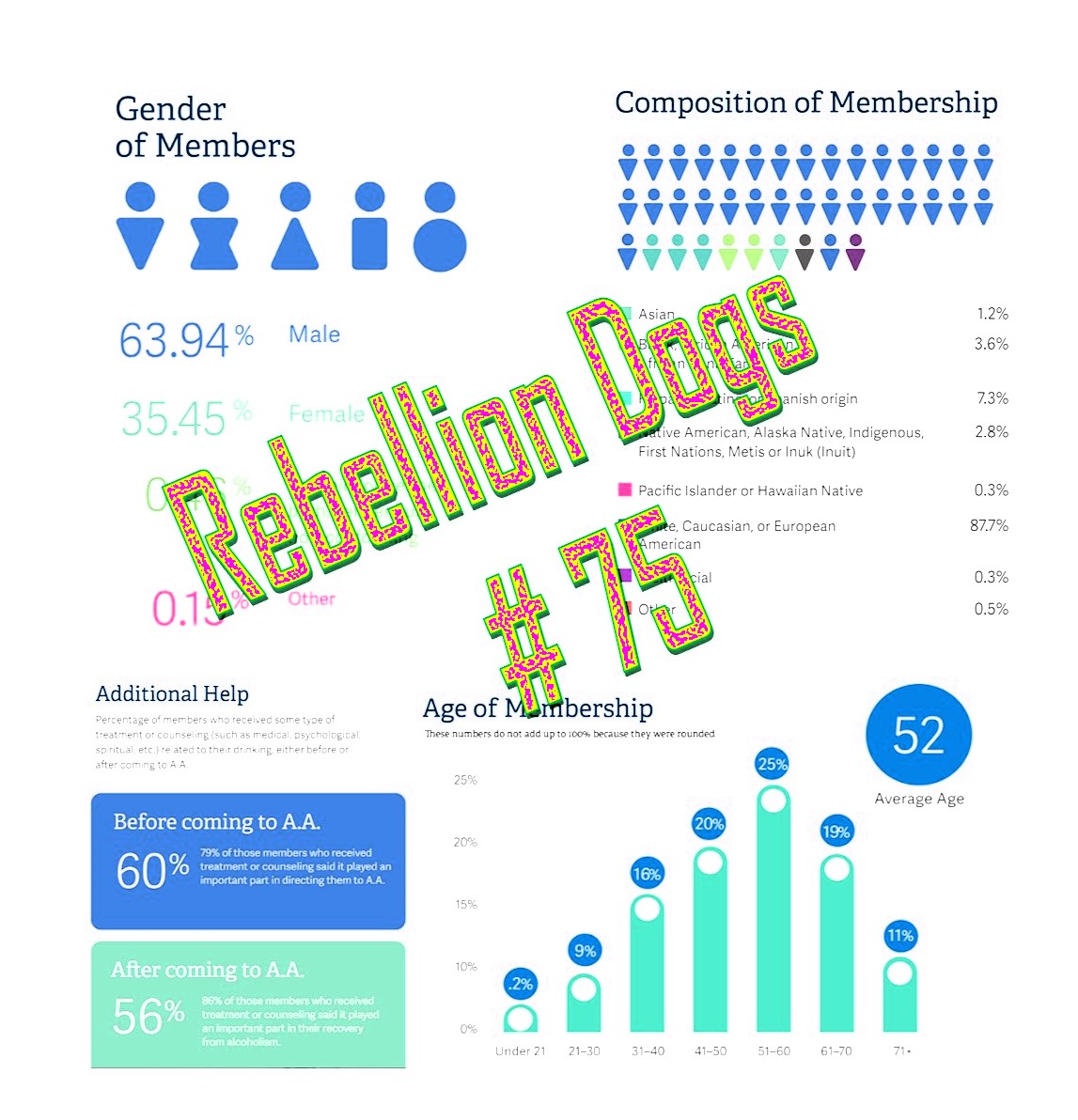
AA's 2011 Membership Survey results are in. What does it mean for AA's future?
| Demographic | 2007 | 2011 |
| Non-white % | 14.9 | 13 |
| Females % | 33 | 35 |
| Average Age | 47 | 49 |
| Average Sobriety | 8 yrs | 9.9 |
| Meetings/week | 2.4 | 2.6 |
| members (Millions) | 1.99 | 2.13 |
| under 21 % | 2.3 | 2 |
| 21 -30 % | 11.3 | 11 |
| 31 - 40 % | 16.5 | 15 |
| 41 -50 % | 28.5 | 24 |
| 51 - 60 % | 23.8 | 27 |
| 61 70 % | 12.3 | 15 |
| 70 + % | 5.3 | 6 |
While AA might be slowing down, according to the World Health Organization, alcoholism is the number one cause of premature death in the USA. Surely death from drinking is prevalent in other developed countries, too. So we aren’t running out of alcoholics. Maybe alcoholics have an ever increasing number of options.
The National Institute for Alcoholism and Alcohol Abuse counts the number of Americans in recovery from addiction at 20 million people. One million of those are AA members (USA numbers). Of course many of recovery nation are sex, food or gambling addicts who wouldn’t be AA members. But it is likely that Moderation Management, SMART recovery, SOS and some of the other secular treatments are more appealing to more alcoholics than an old blue book and a seventy-five year old doctor’s opinion.
What about young people? In the North East urban center I live in, a Public Information rep for AA talked to a school board about having AA youth come in and talk to the students about alcoholism and sobriety. The PI rep was told, “We have a drug and alcohol response program here, but sorry, it doesn’t include Twelve Step programs.” A school board said, “No,” to free alcoholism education and free big books. What is it about AA that is so unattractive?
One anecdotal story of a single school policy does not a scientific finding make. But it is cause for concern. If youth are our future, under 21s and under 30 year-olds are slipping over the last three years and young people in AA have dropped over the last 30 years. Maybe that’s an issue of demographics. Maybe baby-boomer drunks ballooned youth population in the 1970s and 1980s and AA reflects the world outside. The annual international young people’s conference was exceeding 3,000 attendees and growing each year. 1,900 would be good turnout in St. Louis later this month.
These are strategic planning initiatives that AA will surely be contemplating in the years to come. Are there systemic discrimination factors that impact AA population? Cultural, gender and age related issues are possibly at play in AAs aging population? Change and Diversification were the themes of the 2011 General Service Conference. A new big book was considered in the 4th edition printing of Alcohoics Anonymous. We see the same 164 pages surrounded by a few new stories and a bright new cover, but it begs the question—when AA votes for change and diversification, why do we keep things the same?
Reification is a threat to any organization. We aren’t religious but we sacralize ritual and prose which may make us look very religious. It is a point worth asking—what makes us religious, is it how we describe ourselves or is it how we act? Why not take the gender bias out of the text? Why not find a less Judeo/Christian way to describe the God-Steps?
The rest of the world is adapting. Attention Deficit Disorder (ADD) or Attention Deficit Hyperactivity Disorder (AD/HD) is well known to addicts. More people with ADD become addicts and alcoholics than the general population. Advocates of ADD say that the way teachers and doctors treated this disorder when it was discovered would be considered malpractice now. In fact, it won’t even be called a disorder for long. It is one end of a spectrum but it is neither a deficit nor a disorder.
By comparison, people who are over 6’ 3” are very tall—they are at one end of the height spectrum that only 12% of people are in. Taller people don’t need to learn to be average in height. They have to live with the difference and society has to be accommodating. Everyone has some height; it’s just a matter of how much. Everyone is prone to distraction, how often and how frequently depends on if you have ADD or AD/HD or not. It would be absurd to think that better ways of dealing with ADD would be abandoned because we feared change. What if the new way doesn’t work? What will happen to the rest of us?
But isn’t this how AA feels about change? We talk about better ways to appeal to the newcomer and vote against it. Keeping things the same is ego-driven, “Nothing is ever going to work for drunks like what got me sober.” Adapting so that AA makes the newcomers more comfortable and the old-times more squirmy would hold us to our word when we say, “The newcomer is the most important person here; we’re glad you are here.”
Changing cup sizes or offering different beverages is just window dressing. A great deal of time has been spent on AA's website thinking we would increase membershp and attract a younger crowd. It had no impact on youth or total population. We might want to consider getting to the heart of the matter which is then the average person in AA has been doing things a certain way for ten years, the routine has become familiar. Nothing new has been discovered in Grade 8 math in the last 80 years, but they change the text book every decade to keep the langue current and keep the kids engaged.
No magic spell would be lost by changing “God as we understand Him” to “God of our understanding” or “power greater than ourselves.” The first removes the patriarchal slant; the second could open the Twelve Steps to religions that don’t recognize a deity by the name of God or title of “creator.” AA isn’t just New York City and Akron Ohio anymore. AA went to great pains to be inclusive in the first printing of Alcoholics Anonymous. Have we grown complacent since then? If you are thinking, “Yeah but it’s any God you want it to be. It can be Group of Drunks if you want the program to be your higher power,” I say lets look around us and see who is here. What we find is mostly the people who grew up in Protestant or Catholic or Jewish homes. What is it we say to newcomers? “You are crazy to do the same thing over and over again and expect to get different result.” Reification is a progressive disease too, which also may be fatal.
Warning: To worship reason could have us kneeling at the alter of a false god
BILL MOYERS: This one took me aback, because it flies right in the face of my predisposition. “Anyone who values truth should stop worshiping reason.”
JONATHAN HAIDT: The idea of sacredness, the idea of sacralizing something. What I see as an academic, and as a philosophy major is there are a lot of people in the academic world that think, “No sacred cows.” We shouldn't sacralize anything.
But they sacralize reason itself, as though reason is this noble attribute, reason is our highest nature. And if we could just reason, we will solve our problems. All right, that sounds good on paper. But given all the stuff I just told you about what psychologists have discovered about reason, reasoning is not good at finding the truth. Conscious verbal reasoning is really good at confirming.
I say in the book, follow the sacredness. Wherever people sacralize something, there you will find ignorance, blindness to the truth, and resistance to evidence.
BILL MOYERS: So what does, what did the Hebrew prophet mean when he said, "Come now, and let us reason together." Are you saying we can't get at the truth that way?
JONATHAN HAIDT: No. That actually is very wise. What I'm saying here is that individual reasoning is post-hoc, and justificatory. Individual reasoning is not reliable because of the confirmation bias. The only cure for the confirmation bias is other people.
So, if you bring people together who disagree, and they have a sense of friendship, family, having something in common, having an institution to preserve, they can challenge each other's reason. And this is the way the scientific world is supposed to work.
And this is the way it does work in almost every part of it. You know, I've got my theory, and I'm really good at justifying it. But fortunately there's peer review, and there's lots of people are really good at undercutting it. And saying, "Well, what about this phenomenon? You didn't account for that."
And we worked together even if we don't want to, we end up being forced to work together, challenging each other's confirmation biases, and truth emerges.
We’ve heard the expression that an idea is only a bad idea if it’s the only one we have. I have someone in recovery that I bounce ideas off of, that I call a sponsor. He has a turgid little saying. When I am sharing one of my latest, greatest ideas, sometimes after letting me get it out, he’ll sometimes ask, “So what, now you want me to co-sign that bullshit?”
If I make my ideas sacred, I tend to demonize others who have opposing ideas. If I demonize opposing views how can I compromise—I would be betraying my principle. When I treat my view as the truth as a sacred reality, how easy it is to see detractors as delusional while I remain, by my judgment, clear headed. In recovery, in fellowship and in the service of others, there are no absolute truths. If I can tone it down and say that I have one view, they have another, compromise isn’t so difficult. Any society works best when people with converging ideologies work together to sort problems out.
See the whole interview HERE

Barns & Noble have the best price for ePUB fans, Beyond Belief is available for 


The three great existential questions are “Who am I?”, “What am I doing here?” and “Who are these others?” Most of what has been posted in Rebellion Dogs blogs lately is about belief which is critical in grasping “Who am I?” This question is a challenge without perspective—“Who (or what) I am not?” The obvious boundaries are “I am not you.” Babies discover “this foot is ‘me;’ mother and father are not ‘me.’”
An example comes by way of our 2009 Public Information Video aimed at youth. AA has 40,000 teenagers (2% of our population under the age of 21). Decisions made at the Conference might be made on behalf of minorities, but never by minorities. We are trying to make AA better for young people but none are part of the conversation at the Conference level. That's how we have "new" PI videos for "young people" with baby boomer music (Eric Clapton - very uncool). That's the sort of choice 50 to 60 year old AA members would make when asking themselves, “What do kids like?” because it’s what they liked when they were in high school. It sounds great to us old farts but does it resonate with our target audience—today’s teenagers?