


“More human(ist) than human(ist)”
With sincerity, I am very excited to report on this year's World Humanist Congress. But first, let's deal with the “more humanist than humanist” thing. We will get to the serious and fascinating matter at hand. Regular readers can see a request for poetic license coming; I am asking again. Years of art and music festivals leave me with a persistent influence on how I view the world. I can tie it all together.
Tyrell Corp (Blade Runner, 1982) created human clones and marketed them as better—not different—than nature's version of us: The marketing catch-line was “More Human than Human.” I know, that's creepy, dark, and sinister-sounding. But White Zombie ratcheted this dystopia up a notch (1995), at least for those who, late last century, preferred less Spice Girls and Vanilla Ice, and more Metal/Hip-Hop fusion with driving bass, drums, and industrial-sounding slide guitar, and the volume set to dance and deafening:
I am the Astro-Creep, a demolition- style hell American freak, yeah.
I am the crawling dead, A phantom in a box, shadow in your head
Scratch off the broken skin, tear into my heart, make me do it again, yeah.
More human than human; more human.[i]

A first for me, the 21st World Humanist Congress was hosted in Ottawa, Canada, August 7th to 9th, 2026. I got there before the crowd. The scene is a ready-for-action fourth-floor conference room, facing the Canadian Parliament buildings, an empty stage against the window, vertical banners, empty seats, a not-yet-staffed refreshment bar. The banners were bright and beautiful, all good. Outside the conference room, organizers and volunteers scamper to get the foyer ready for a sell-out crowd. I don't know why I thought of White Zombie while daydreaming about a catchy theme song for humanism.
Is dystopian heavy-metal sci-fi music too polarizing? Is it so last-century? My first ideas aren’t always my best ideas. I know, I know, it's not the middle-of-the-road that everyone can get behind.

Maggie Ardiente (President of Humanist International since 2025), was previously president of the Secular Coalition for America, with opening comments Friday, August 7th.
Humanists from around the world were arriving, determined, dedicated, mindful of cultural and political issues of the day and still optimistic about the enduring nature of humankind. I think a more cautiously optimistic genre should be explored… at least in terms of something everyone could willingly sing along with. I know enough to keep this bright theme-song idea to myself. I won't be pulling a busy organizer aside to tell them about my “helpful” suggestion.
As delegates settled in, some reconnecting with friends they haven't seen in a year, the welcoming address, author/philosopher Rebecca Goldstein [ii] made the case that “Humanism has the goods to remake the world,” and made the point that we’ve faced grimmer circumstances before and recovered from adversity.
The bar opened, the piano and accompanying instruments came out, and what sealed the deal for the audience was the irresistible sing-along to “Sweet Caroline” by Neil Diamond. “Good times never seemed so good. I've been inclined to believe they never would, oh, oh, oh.” Of course, who here knows the words to White Zombie songs, anyway? I do love music, but I do not have such a knack for the obvious. More humanist is more hopeful than dystopian science fiction.
But there is something about a theme I heard from panels, keynote speakers and over coffee. Being humanist comes with a value system; there is no doubt about that. But the “more humanist” part of the identity is how we live. Here is what this year's Congress host, Humanist Canada, says about what being more Humanist than Humanist means:
As Humanists, we believe in a life stance based upon respect for human dignity and the conviction that we are ultimately accountable to ourselves and to society for our actions. Our worldview is deity-free and affirms our ability and responsibility to lead ethical, meaningful lives.[iii]
So it’s not just about what we politely and quietly believe. Humanism can, but often does not, slip into smug and superior solidarity. More humanist is an action that coincides with a secular worldview. “There will be a call to roll up our sleeves this weekend,” me thinks, as the Friday opener winds down.
Feeling unsafe in the land of the free
Not to bury the lead in my nostalgic side trip on alt-rock poetry, there was a relevant reason that the 2026 Congress was driving distance for me this year. Originally planned for Washington, DC (also driving distance, really), in consideration of the diversity of countries, ethnicities and political circumstances of the attendees, an announcement was made just months before the event: Due to America’s political climate, organizers could neither assure entrance into the USA for foreign travellers nor assure their safety during their stay.
In response to growing hostilities emanating from the US administration de jour, organizers decided to relocate the 21st annual gathering. So on short notice, and with a Canadiana “You betcha’ eh; I am so sorry!” chorus of solidarity from the Humanist cousins to the North, here we are in Ottawa, Canada.
Polls suggest the American administrative policy doesn’t represent most Americans. These anti-diversity, racist, misogynist, queer-phobic policymakers don’t even represent most Republicans. Most Americans are embarrassed and share our horror. Still, voting with our feet is a step towards change and a voice against authoritarianism. Making this cross-border statement is just the kind of action-not-just-belief ethos of Humanism. And here we are, just steps from the Canadian Parliament buildings; wouldn’t Mark Carney be proud of us?
Over 500 people from over 40 countries attended World Humanist Congress #21. The theme was "Humanism as Resistance. “Resistance to what?” I wondered. “Can’t we just shine a light and forgo fighting the darkness? We can be good examples or rational, stewardly humanness without pumping our fists in opposition, can’t we?”
As anyone devoted to reason, I concede that this is not a this-but-not-that answer: Yes, be a good example, and also, when you see something, say something, or more impactfully, do something. Moving the congress outside the USA was an act of peaceful resistance—not merely a reactive impulse.

Addressing the threat of tyranny and oppression to democracy,
Fish Stark (Executive Director of the American Humanist Association)[iv]
spoke of the current political climate in the United States of America…
“We need to do more than oppose Christian Nationalism. We need to be the opposite of Christian Nationalism. Humanism has always repudiated all systems that treat dominance as acceptable or human worth as conditional. We are the opposite of these ideas that Americans are starting to hate right now, and we need to show it.”[v]
How many Humanists? Professor Sarah Wilkins-Laflamme or the research and worldview
Herding humanists is partly a question of who gets to apply the label. Around the world, secularization continues to grow, but people do not fit neatly into uniform census categories. Some who identify with an organized religion do not believe in Gods, at least not in a supernatural or interventionist sense. Others who have left a temple, synagogue, church, or similar institution still believe in a higher power.
Here is some data from recent census reporting.
Country |
No Religion |
No belief in God(s) |
USA |
46% |
44% |
Canada |
44% |
41% |
UK |
62% |
52% |
China |
87% |
83% |
Netherlands |
62% |
56% |
Chechia |
77% |
62% |
So, 6% of Americans self-identify as Humanist, and 9% of Canadians do. Would others fit the criteria? Sure. Not everyone likes labels; what I call “Apatheists” self-describe as “don’t know—don’t care. Can we talk about something more interesting?” And then, we have the “But I am spiritual—not religious” identification. “SNRs,” as Professor Wilkins-Laflamme refers to this demo in her statistical work.
If you love trends and numbers as I do, join the conversation as Sarah Wilkins-Laflamme sits in with Rebellion Dogs Radio for an in-depth and entertaining chat about what’s trending where and for whom. Episode 88: Rebellion Dogs Radio with Sarah Wilkins-Laflamme (Click to Listen)
Dr. Kristopher Wells is a Canadian Senator and has received honours for human rights advocacy. He has been an educator, a former Canada Research Chair and the founding Director of the MacEwan Centre for Sexual and Gender Diversity. Well’s research helped establish foundational safety and inclusion policies in Canadian schools. Speaking of the Canadian Charter of Rights and Freedoms, Senator Wells articulated how the Charter ensures:
- the rights of belief and non-belief.
- LGBTQIA+ right to marry.
- Freedom from discrimination on the basis of gender, race, and sexual orientation.
- Healthcare for all, regardless of ability to pay.
- Public funding for research, education, and science.
“We believe in evidence,” Wells reports. “Canada ensures equality, no matter who we love, what they believe or where we are from.”
London School of Economics Professor Francesca Klug (Centre for Study of Human Rights) has advocated, rolled up her sleeves, and lectured on human rights for 30 years, including advising the British Government on its 1998 Human Rights Act. Klug serves as a trustee for several international human rights NGOs. We would all have been well served by spending a semester or two with Professor Klug but, with the hour available, she gave us a summary of the subject of her 2015 book, A Magna Carta for All Humanity: Homing in on Human Rights. At this point in history, a brush-up on the 1948 Universal Declaration of Human Rights (UDHR) served as a commentary on current news, rather than a civics lesson.
Human Rights as Resistance?” Let’s consider context: It’s 1948; more of the horror of Jewish genocide was coming to bear; the first and then second nuclear bombs killed tens of thousands more innocent civilians in Japan than ever before in history. This backdrop underscored the urgency for the United Nations UDHR.
The UN General Assembly in Paris proclaimed this declaration. Therefore, countries do not ratify the UDHR itself. However, its principles inspired binding international laws. Who does it cover? Everyone, regardless of belief, property, race, gender identity, origin, or place of domicile. Professor Klug was met with applause as she declared that the UDHR has been translated into more languages than the Bible. There are monitoring bodies, a Human Rights Council, and diplomatic and public pressure brought to bear, for instance, from organizations such as Amnesty International.
Today, these fundamental rights, or inalienable rights, are front of mind because of credibly labelled war crimes of genocide, unprovoked and illegal wars started, human rights violations being acknowledged and reconciled, while new violations are happening in many regions of the little blue planet, third from the sun (cue the Five Man Electrical Band to sing, “I’m a Stranger Here (1973)”[vi] to continue in the musical side of our program).
I see the aeroplanes carrying the bombs.
Why you've even found people to drop them on.
You know you can't keep what you take by force;
But it's only my first impression, of course.
I’m a stranger here on your planet Earth.
Francesca Klug reminded us, through the brief history, that resistance to human rights violations today is, in good measure, a reminder to the democratic world of its/their values.
We are all migrants; we are all rights-bearing humans.
“ICE-breakers in the USA, and voters in Europe have demonstrated what resistance to authoritarianism and populism look like. We need to do more.”
Panel on ‘Humanist Legislators’
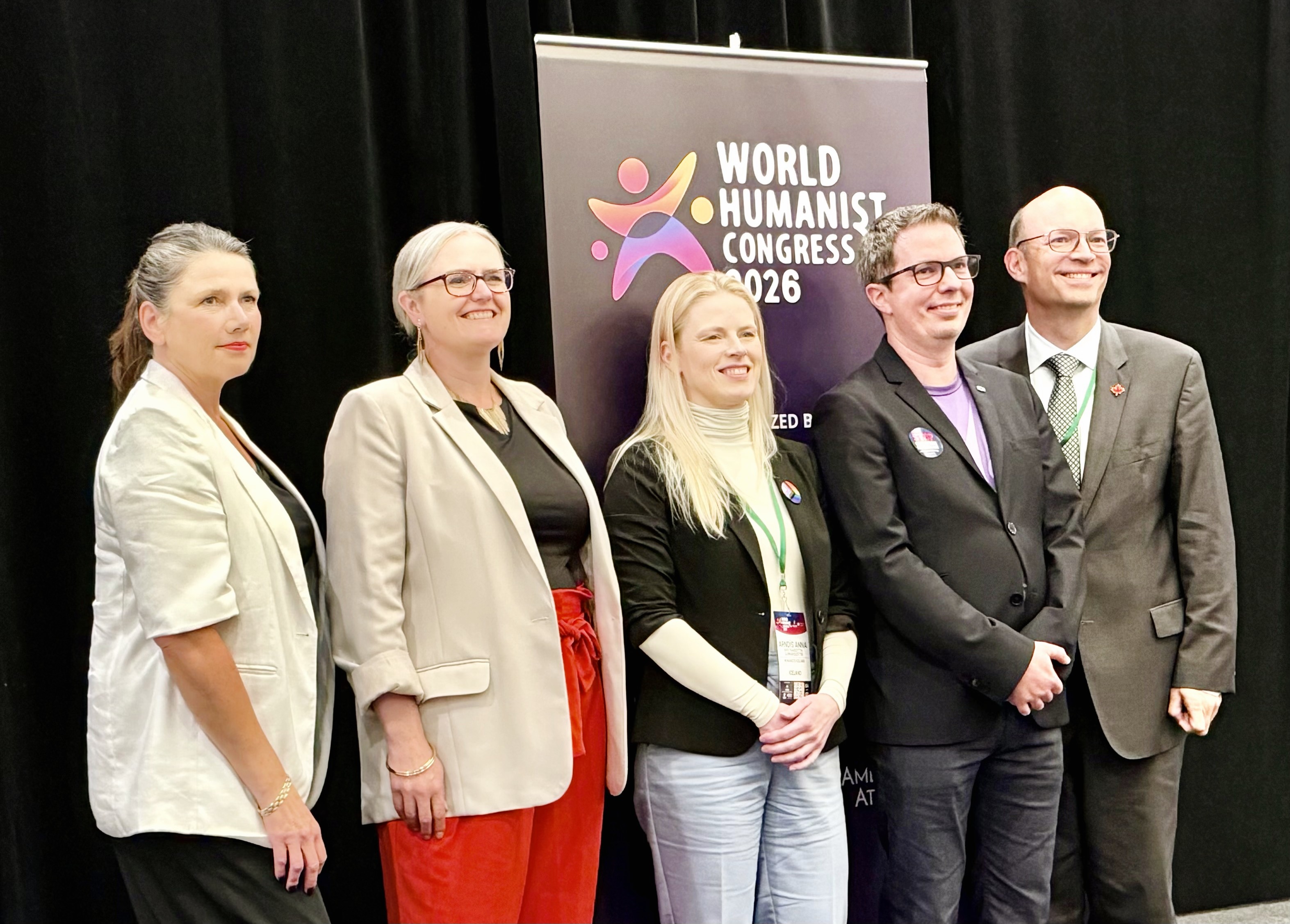
Left to right, Heidi Nordby Lunde (Norwegian Humanist Association), Lizzie Collinge (Current UK Labour Party MP), Arndís Anna K. Gunnarsdóttir (Humanists Iceland), panel chair, Ian Bushfield (BC Humanists), and Canadian senator Kristopher Wells, in a discussion about humanism in politics. Imagine if, in North America, all irreligious public servants could be candid about non-theistic views and practices? How many closeted humanists/freethinkers/atheists in public service are closeted about their worldview? And why be closeted? Many people have an irrational fear and/or hatred towards non-theists. This was expressed in an article written called, “Why Americans Still Hate Atheists,” introducing the term “secularphobia” by Phil Zuckerman to Psychology Today readers in 2014.[vii] Each panellist described their political life and encouraged others to get more involved. This could help normalize humanist/secular life. More normalization of irreligious public servants tilts the scale to a more secular, more inclusive culture, where future politicians can be more unabashed about being good without gods.
This is your Philosopher on Hope: A.C. Grayling, British philosopher and author
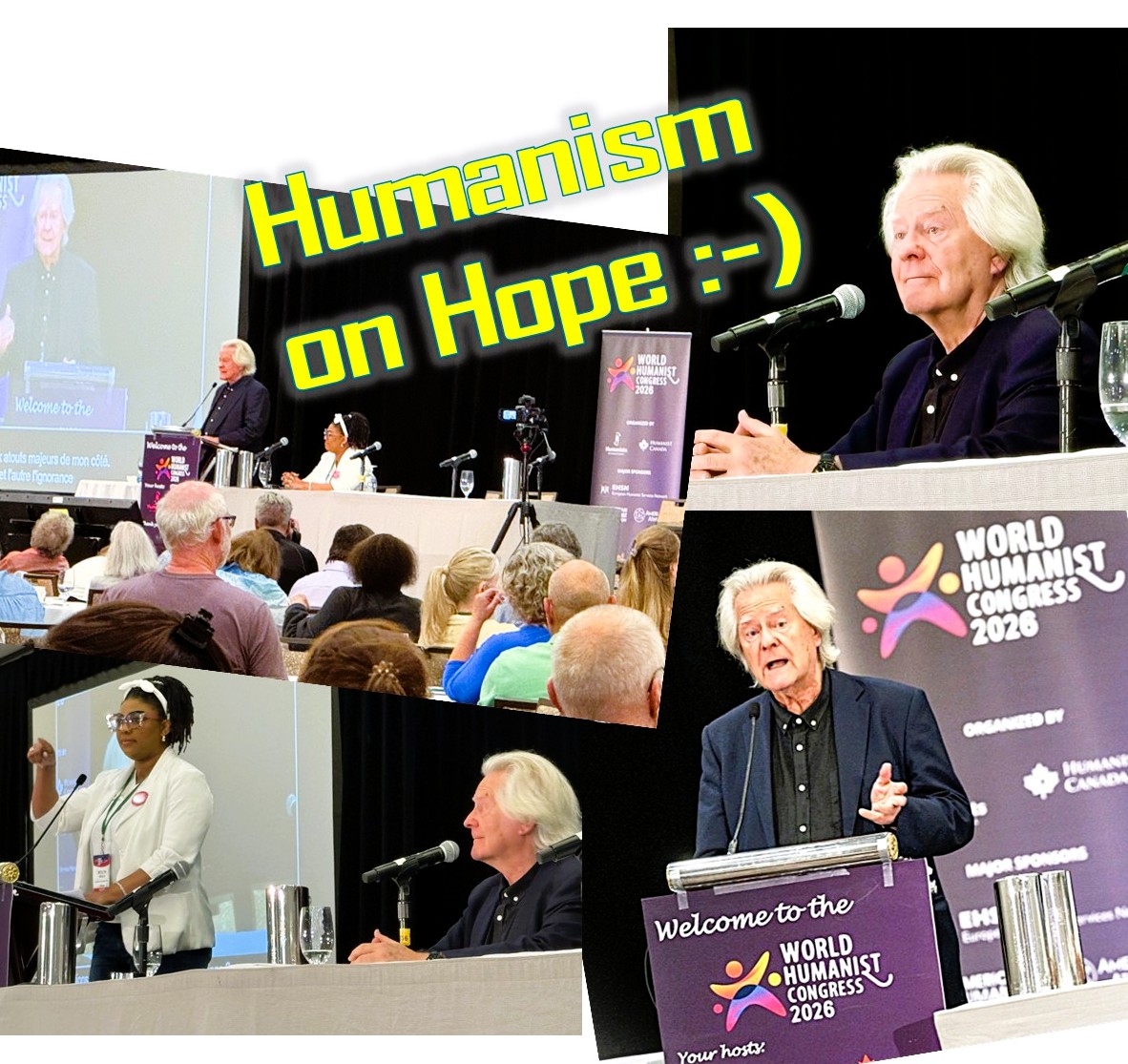
Anthony Clifford Grayling, author of about 30 books including:
- Discriminations: Making Peace in the Culture Wars (2025),
- The God Argument (2023) and The History of Philosophy (2019),
and for next-gen cred, join 2,000 subscribers @acgrayling on Substack [viii].
Born in Northern Rhodesia, he also spent his childhood in Nyasaland. From 1991 to 2011, A.C. Grayling taught philosophy classes in Glasgow and London. Grayling is Vice-President of Humanists UK[ix]
Here is Grayling digging in Sunday afternoon (August 8, 2026) in Ottawa:
“My theme is ‘Hope.’ There are only two ways to pigeon-hole hope: i) a rational thing, or ii) an irrational thing.
The irrational aspect of hope ranges from buying lottery tickets to the last-chance attitude one has at the moments of deepest despair. I expect that all of you were reading in bed last night, Albert Camus’s The Myth of Sisyphus (1942);[x] so you remember that he says the great philosophical question is whether or not to commit suicide. Because if the answer is, ‘No,’ then it is because you have a reason to live; there is a reason to go on. And even in the darkest moments, our most despairing times, there is something we will hope for; we will hope for a miracle; we will hope against hopelessness.
Hope, in that way, can be irrational. But even irrational hope is not such a bad thing. After all, we need to have dreams; we need to have wishes. It can sustain us.
But the really valuable kind of hope we have been hearing about over the last few days is a rational hope. It is the hope that can engage with possibilities. It is hoped that, as we confront the difficulties in our world at large, and in our individual lives, something can be done. Some action we can take, some contribution we can make, that would bring about a better situation.
Perfection—outside of this room of course—is very difficult to find in this world. We can specify to ourselves ideas; we can try to approximate as closely as we can the ideal that we postulate for ourselves. The question is, ‘What forms does that endeavour take?’
We’ve had some very good ideas today about how this could be so. Each one of us has an opportunity, a talent, an interest, a bent, that we can make use of, to reach out to one another, to bear witness—as our religious friends on the other side of the debate sometimes say—to where we stand and what our views are, which is to show people a way of living that:
- Is principled
- Is ethical
- Which cares about humanity
- Which brings to bear ways of thinking and styles of thought
- Addresses the questions that we face individually and collectively.
That is humanism.”
Of being a humanist, by leaning into the world with reason and empathy, A.C. Grayling challenged me, and everyone, to consider stepping out of my comfort zone, of being humanist as a private and personal state with the call to being more actively humanist in a world, at a time that reason and empathy are in short supply.
“Maybe in the end, all these different endeavours in which thinking about things have brought you back to that moment where you should no longer be a functional atheist but an active one.”
Grayling called out to the previous discussion of human rights with the idea of seeking every opportunity to collaborate with others on promoting these rights, regardless of either our affiliates or our benefactors, beliefs, or commitments—provided, of course, that they too are as committed to the idea of human rights as we are. Everyone should be approached with sympathy and generosity.
Living with clarity and charity.
“For me, charity is what lies at the very heart of humanism—the idea that we should approach our fellows, whoever they are, wherever they are, with sympathy and generosity, trying to approach them at our best and most generous understanding of human nature and the human condition.
It is very difficult to understand fully what human nature is, of course. It takes each of us a whole lifetime to understand ourselves, so how would you understand other people?
But we can make the effort. Certainly, we understand something about the human condition, in a world which is desperately unequal, in the world where the sheer bureaucracy of life—even if you have a moderately successful career in this world—think about how much time you spend paying bills, and filling in forms, and getting visas and passports, and buying tickets. You know, you just think to yourself of the good old days 10,000 years ago when forms were not the key to solving our existence.”
This off-script musing got the crowd laughing as he recounted the 24-hour-plus delay to Ottawa while dealing with his weekend visa. Back to Grayling’s Sunday message from the pulpit, which closed off the 21st World Humanist Congress:
“This empathetic and generous view of other human beings is how we should begin. We should give other people exactly what we give a painting. As we do with the painting, giving each person the advantage of putting them in the best lighting, and let us hope that human connection can be made.”
Grayling identifies the reasonable exception. “When people cross the line, when people do nasty, greedy, selfish, unkind and cruel things that is beyond acceptance, we don't accept that. We must be tough about that. You know, people who tend to be rather liberal, that liberalism is very tolerant and therefore it tolerates the intolerance for too long, and that is something that we have to think about.”
Reflecting on discussions with students, Professor Grayling explains why bad news seems to be the only news. He argues that human decency is commonplace, so it’s not news. Greed and destruction are news because they interrupt the norm. “News spaces are full of reports about atrocity and murder because this is relatively rare in our world. Every second, everywhere in everyday life, the standard means of interaction between people is polite, is decent, is reasonable. We do not see on the front page of The New York Times, ‘Shopkeeper is polite to customer.’ That’s not news. And that is something that we have to build on; we have to build on the fact that we are sociable creatures. We need one another. We need our friends; we need to love and be loved; we need to be part of the community.
One very great way to be part of the community is to be a contributor—be a humanist. It seems to me that we humanists ought to let people know that we are humanists and what that means, in this non-religious, ethical algorithm, which is the value of a human life from cradle to the grave. It is this life that matters, in this world, today.
But doing something, not just saying it. Human rights efforts, taking part, as we have discussed, liberal community initiatives. We display our commitment to other human beings not because we profit for ourselves, but because we care about the humanity of it.”
Grayling talked of his friends and colleagues, such as Christoper Hitchens and Richard Dawkins, sometimes joking about their sense of accomplishment from taking religion down a peg, dismantling the constructs from which people glean hope. Many in the crowd had witnessed the articulate and clever debates of these infamous atheists, in person or on YouTube. Ought we offer something to replace the hope and connection we are “freeing” theists from? And that something, Grayling suggested, is humanism. In so many words, all the hope and connection, with no invisible means of support.
As the best-attended Humanist Congress ever, this is the natural evolution of apostasy and a growing normalization of irreligious worldviews and communities. If you’re not sure what resources and connections are available to you, Google local, regional, and national humanist/humanism organizations, which you can find in just a few clicks. If you don't have a local humanist chapter where you live, well, what type of person would it take to establish such a chapter? Yes, “let it begin with me” is also more humanist than humanist. You're not alone; contact the national organization, and they could help. They may already be in contact with like-minded individuals close to you.
Besides White Zombie, another more humanist ethos I was reminded of came from late-1990s fiction. Jeff Bridges' character in the Coen Brothers movie The Big Lebowski inspired a real, although satirical, religion, The Church of the Latter-Day Dude in 2005. This no-dogma collective's mantra is:
Dudism: Don’t be an asshole. Beyond treating others with kindness and respect, everything else is up to you.
If the ideas expressed here land with you the way they did for me, feel free to continue your journey with some of the links you’ll find below.
Humanists and World Humanism Conference in the news on Ottawa TV
Get to know Executive Director of Humanist Canada, Janalee Morris and her lifelong humanism
Rebecca Goldstein keynote speaker Friday night at the World Humanist Congress on The Mattering Instinct. Read on LinkedInor read on Facebook
Rebellion Dogs Radio Episode 88 features Saturday morning keynote speaker, Sociologist and researcher Sarah Wilkins-Laflamme, as we share thoughts about the Congress and discuss her presentation, including information about the growing trend away from religious affiliation and belief.
- Listen to Sarah Wilkins-Laflamme on Rebellion Dogs Radio
- Photos from Ottawa World Humanist Congress 2026 (Meta/Facebook)
Visit the links below…
[ii] Rebecca Newberger Goldstein, The Mattering Instinct on Rebellion Dogs Facebook https://www.facebook.com/share/p/1DXF1Z9c4o/
[vi] I’m A Stranger Here https://youtu.be/CeVhhHRDcQU?si=8USBVtH00kD_p_7x
[vii] Phil Zuckerman, PhD, Psychology Today, https://www.psychologytoday.com/us/blog/the-secular-life/201406/why-americans-hate-atheists
[viii] AC Grayling on Substack https://acgrayling.substack.com/
[x] Camus, Albert, The Myth of Sisyphus: It is legitimate and necessary to wonder whether life has a meaning; therefore it is legitimate to meet the problem of suicide face to face. https://dn710009.ca.archive.org/0/items/persepolis_202107/The%20Myth%20of%20Sisyphus%20-%20Albert%20Camus.pdf